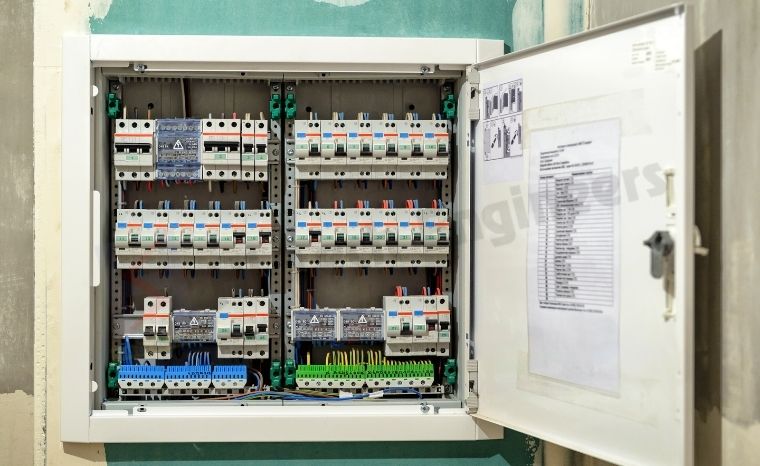
One of the most significant parts in any electrical system is the Distribution Panel Board. It is used to safely distribute electricity in a building or industrial plant that has its main power source to various circuits. A distribution panel board is deployed in the home, office, factory, or hospital to ensure a smooth flow of power and the safety of the electrical equipment from damage.
In this blog, we will describe what a distribution panel board is, how it operates, its parts, applications, and its advantages in a simple and easy-to-understand manner.
What is a Distribution panel board?
A distribution panel board is a type of electrical control panel that is fed by the main supply and supplies several circuits. Individual circuit safety devices (MCBs (Miniature Circuit Breakers)) or MCCBs (Molded Case Circuit Breakers) protect each circuit.
It is primarily aimed at allowing the distribution of power in a safe, organized, and controlled way and avoiding electrical faults.
How Does a Distribution Panel Board Work?
The process of working is not complicated:
The main supply supplies power to the panel.
It is through a main switch or isolator.
The power is then split into various circuits.
Every circuit is provided with a separate breaker.
When a fault is experienced, it only trips that particular breaker.
This system provides that issues in one part do not have an impact on the whole electric system.
Principal Elements of a Distribution Panel Board
A typical distribution panel board contains:
Main Switch: Activates/deactivates the full power supply.
MCB/MCCB: Shields overloaded and short circuits.
RCCB/ELCB: Eliminates electric shock and leakage current.
Bus Bars: Transmit electricity to various circuits.
Indicator Lights: Indicate power.
Enclosure: Covers internal parts.
All of its components are essential to the safety and smooth functioning.
Where Does a Distribution Panel Board Go?
The distribution panel boards are applied in numerous locations, such as:
Residential buildings
Commercial offices
Industrial factories
Hospitals
Shopping malls
Hotels
Schools and colleges
In order to manage power properly, every building containing electrical wiring will need a distribution panel board.
Distribution panel boards Types
It has various forms in its usage:
Single-Phase Panel
It is utilized in homes and small offices.
Three-Phase Panel
Applied in industries and business premises.
LT Distribution Panel
Applied to a low-tension system.
Power Control Panel
Applied to heavy machinery.
All of them are made depending on the load capacity and usage.
Advantages of a Distribution panel board
Electrical Safety
Insures against short circuiting, overloading, and electric shocks.
Easy Maintenance
Defects are readily found and addressed.
Organized Wiring
The circuits are all controlled in a single location.
Power Control
Enables the ability to turn off and on individual circuits.
Energy Efficiency
Assistance in the distribution of loads.
Applications in Industry Importance
A distribution panel board is used in industries to turn machines, motors, and production lines on and off. It maintains constant voltage and avoids damage to equipment. A good panel design will enhance productivity and reduce downtime.
Maintenance Tips
In order to live long and be safe:
Check breakers regularly
Clean dust from the panel
Tighten loose connections
Replace faulty components
Perform routine inspection.
Unexpected failures are avoided by proper maintenance.
We say that
A distribution panel board forms a necessary component of a system of electricity. It is safe in distributing power, safeguarding equipment, and even facilitating uninterrupted work. These panels are important in the management of power, whether they are in homes or other large industries.
The knowledge of a distribution panel board operation assists the user in being safe and efficient. Having a high-quality panel that is designed with good performance, less downtime, and long-term protection of electricity is a surety of reliability.